Showing posts with label Russia. Show all posts

Tuesday, December 4, 2012

Mother's Love - The Other Side. Series of photos by Anna Radchenko

Surfing on Web in search of the interesting pictures I've come across this really shocking, but very well done and making you think over a lot, series of photos. It's made by the aspiring Russian photographer, Anna Radchenko, who's currently going to make her personal exhibition in London. Anna is a well-known wedding photographer who also does fascinating portraits and non-standard photo series.
"The Mother's Love" is one of first art series to disclose the difficult and confusing problem of over-controlling or, vice versa, ignorant and neglecting mothers who make psychological traumas to their children and call their hurtful behavior "love". With the help of symbolic tools, Anna Radchenko and her models have managed to clearly show the other side of mothers' love. Here are some of the most striking photos from the series:

So, what's that, love of the mother?

It can be the desire to replay your unhappened life in the life of your child. The girl's become a ballerina because her mother has never had courage to do that. 

The mother can protect your from "this violent world" and she will never let anybody to approach you. She will say you that the world is cruel and you'll be afraid of it constantly. 

The mother will force you to be too timid and shy in order to look better alongside with you. 

The mother will chain you to one place in order you won't explore this world and become independent. 

The mother may manipulate you in order to achieve her goals through you. 

Your mother may require that you will consider her the main person in the world. 

The mother may think of you as of a baby even if you are an adult. 

The mother may be just ignorant and not pay a lot of attention to you. 

Or, the mother may just hate you and think of how to get rid of you.

You can see Anna Radchenko's portfolio here: http://www.mywed.ru/photographer/view/profile/Tabirisk/

Friday, November 23, 2012

Green Social Advertisements - Yellow, Concise And Laconic

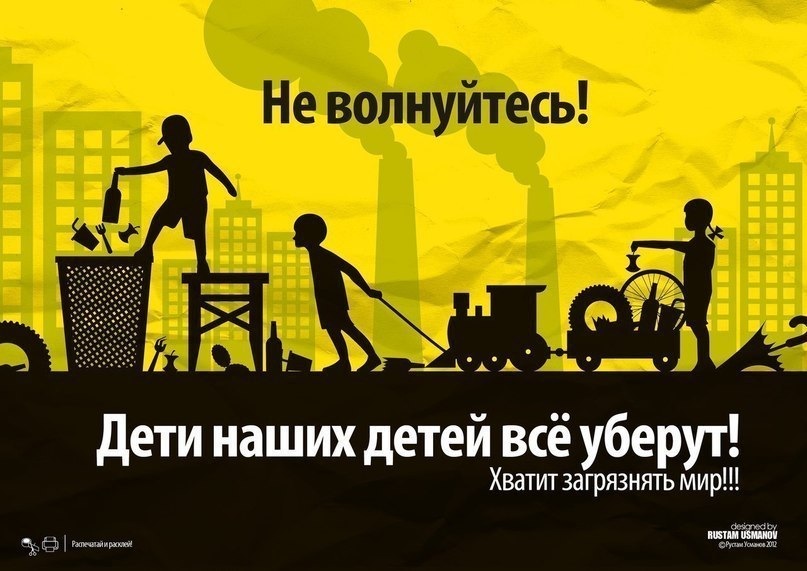
This series of social advertisements promoting the "green" lifestyle and the environmentally aware approach to your life has recently grabbed my attention as something new and persuasive. The yellow and black color scheme, the precise and laconic graphics sometimes reminding the newspapers' and websites' info-graphics and short but impressive slogans make this series a really great social advertising solution. After you've looked at these ads you can feel that you are really eager to protect your environment and to change your lifestyle to the "greener" one. These ads are as following:

The garbage's way to the waste bin goes through our mind!
Be more mindful! 

A small victory for you!
A big victory for the humanity!
Start defeating pollution! 

Your garbage can be the accidental reason of the other people's trouble!
Don't pollute the nature!

The Internet is against pollution!
And you? 

We have had to stop turning our woods into the waste site for a long time!
Don't pollute the nature!

To be a human!
It's not a duty! 
Be humans!

Don't worry!
Our children's children will clean up everything!
It's enough to pollute the world!

Teach good manners to your children!

You have littered your house - don't litter up the others' one!
Don't pollute the nature!

So, these precise, graphical black images on the yellow background are really eye-catching and slogans are well-thought. These ads make us think of the environmental problems and of our children's future. 


Friday, November 16, 2012

Really Strange Social Advertising

I've recently discovered some strange samples of the Russian social advertising. They are about disabled people and that we shouldn't pay attention on their disabilities. Generally, the message is like "OK, we are all different and that's great". Advertisers chose to emphasize this difference via comparing disabled people with some controversial artworks, like Malevich's "Black Square" etc. "Yes, you may not like it but it's still the art".  I think it's not very politically correct, at least. May be, a disabled person may be offended by such a comparison. Advertisers have stepped on the slippery ground, anyway. Let's have a look at what they've done.

Picture - Art
Look at deviations from the norm in the another way. 
Every disabled person can be great. 

 Fruit - Brand
(the text is the same as it is on the previous picture)

Tower - Legend 


The design is quite minimalistic and primitive drawings are in fashion now, but anyway, I think it's a rather bad sample of a social advertising campaign. Yes, "Black Square" is a great masterpiece, Apple Inc. is a great company which has changed our idea of electronic devices and Pisa Tower is the great landmark of this Italian town, but the idea of deficiency compared with "the norm" (a lifelike, realistic picture; a "whole" apple; a straight-standing tower) lies behind this "appreciation of greatness".  "Deviations from the norm" is a bad idea for a slogan, anyway. Who is defining this norm? Especially if we are speaking about people? I believe that many handicapped people really suffer from being "special" and from the constant emphasis on the idea that "they are not like normal people". This advertising campaign may only make things worse. 

But, may be, I'm not right and this idea for ads is really great. What do you think about it, by the way?

Friday, October 19, 2012

Stalin for teenagers - a new social ad campaign

75 years ago General Secretary for the Communist Party in the USSR, Joseph Stalin signed the resolution which started so-called "Big Terror". People of different ranks, positions and occupations were arrested for some fantastic and baseless reasons and then tortured in the NKVD (Stalin's secret police) cells, sent to prison-like labour camps in Siberia and the North of Russia. Among them were writers, poets, artists, scientists and scholars, doctors and factory directors, priests and descendants of former Russian aristocracy and merchants. One of most popular accusations was espionage for some capitalist countries adversary to the USSR. Many prisoners of the GULAG were disclosed to the police by their neighbors and friends.

Thus, these years of "Big Terror" can be considered the real tragedy of the Russian people. Not only privileged classes and intellectuals suffered; many ordinary people, peasants and workers were arrested and tortured too. The reasons for such unprecedented measures can be numerous - Stalin suspected that there would be a treason against him among his fellow Party members (so, many of those who were arrested weren't anti-Soviet at all; they were ardent Communists and hoped till the end that they had been sent to the labour camp for some terrible mistake and they would be released as soon as Stalin would be informed of that); that there were really some profound reasons to look for foreign spies in the young, but thrivingly developing industrial state as the USSR was in those times. People who idealize Stalin (as it's fashionable among some Russian people today) say that severe measures and repressions were necessary for "keeping everything in order". But still, there is the issue of  great controversy. Although the cult of Stalin's personality and his repressive activities were given a negative estimation of politicians and Communistic activists as early as in the beginning of the 1960s (to such extent that Stalin's monuments were destroyed, his portraits and posters with his face on them which had been in abundance earlier were banned and the Soviet anthem with lines about "great Stalin who has lit the way for us" was rewritten), many people felt that they couldn't accuse Stalin in all sins of those times. The charm of Stalin's personality is still very strong. Nowadays, some Russian people have even started to romanticize his image. If you have a look to the Russian internets, you'll find a lot of Stalin's fans.
The Russian Non-Profit Organization for Victims of Illegal Political Repressions is warned by this fact. Its activists say that the reasons for increasing of Stalin's popularity among young people is that they are not informed about the extent of Big Terror and think that it was long time ago and all sources lie. Moreover, teenagers and youngsters don't see any links between the 1930s events and their own lives.
So, activists have invented an original way to tell the history for the new generation who has grown up with the Internet. The series of social prints "Stalin - he is like..." has appeared recently and immediately grabbed my attention. Here are some of them.

Stalin - he is like Foursquare: he showed who belongs where. 

Stalin - he is like Yandex: he used to send search enquiries. 

Stalin - he is like Facebook: he called for sharing information 

Stalin - he is like Twitter: he was brief. 

Stalin - he is like YouTube: he allowed loading and sending. 

Stalin is like VKontakte: he captivated millions. 


The common slogan for this social ad campaign is: "Big Terror 1937-1938. 75 years are not the time to forget". 

As you pay attention you'll also see the very good job of graphic designers. They have played with logos of social networks and their interfaces in order to blend modern features with historical content. Twitter's bird becomes Stalin's mustaches; Facebook's sign for "Like" is completed with the famous Stalin's pipe; and features of VK's interface (function buttons) are rewritten with "To send a telegram", "To add to comrades", "To declare a people's enemy". In the left corner one can read some historical facts and figures about Big Terror. 

I think that is the well-done job; ads are not very pathetic and sentimental, but rather quirky and even funny (a sort of black humor). And they really make you thinking of Big Terror and its tragedy. 

Thursday, October 4, 2012

Hand-made movie posters

Great cinemas with all novelties one can imagine haven't reached small towns and far-away city districts. In Russia, there are still a great number of small cinemas with very cheap tickets, screeching chairs and unheated halls where you can watch the movie which was on top-charts 2 or 3 years ago. Some of such cinemas are on the verge of extinction, since almost nobody visits them despite of their cheap prices - who wants to see the old movie having Internet to download it or a DVD to watch it at home? So, many of these small oldtimer cinemas have already closed their doors, having been turned into nightclubs or more modern cinemas, but a part of them still works, especially those located in far-away towns. The administration of such leisure facilities often has no money to renew their repertoire regularly and to cope with the speed new movies are shot, so they offer movies with great delays. And I must admit, it's very good if you wasn't able to see the movie when it was shown in a duplex, but still want to see it on the "big screen" of the cinema, not just on a small screen of your computer or TV set. Moreover, they often don't have opportunities to buy official movie posters, so they employ artists and painters which redraw images from photos or even invent something new.

Handmade movie posters painted by a decorator on large boards and displayed outside the cinema are well-known to many people lived in the USSR. Since there weren't any uniform "official" posters, presented by a film-maker, as it is now, an artist made any images he or she liked to.  Now things are not the same and every cinema displays "official" uniform posters, but small cinemas with old repertoire cling to the tradition to draw movie posters by their own means. Artists who create such "masterpieces" have different level of skill and talent - some are really good and others draw something only remotely reminding us of actual movie settings. But there is certainly something nostalgic to see these "homegrown", often awry posters displayed on the facades of old cinemas in the city suburbs or in small sleepy towns.

Here they are:

The Fast and the Furious

The Matrix Reloaded

Avatar

The Day Watch (Russian fantastic thriller movie made in 2004 upon the novel of fantastic writer Sergey Lukianenko of the same name). 

Ice Age
(O_0, this cinema has 3D! And if you look at this hand-made poster, you don't expect such technical advance present in this cinema...)

Anaconda 2

As we see, some of these posters are just redrawn from official posters, some are made by artists who have only remote understanding of what the movie is all about and others are made upon the artist's impression. So, the old craft of public decorator arts is still preserved on the local level. And who knows, may be, photos will be out of fashion and all posters as well as advertisements will be made by the hand of an unknown artist (as it was long ago). 

Thursday, September 20, 2012

Be close to your children - a social ad raising difficult questions

A new masterpiece of social advertising has created much response and strong reactions of my friends in Facebook and LJ. Unknown advertisers have decided to create minimalistic but a very touching ad which raises  uneasy issues of teenage pregnancy, parent-child relationships and abortion.


A good-looking teenage girl is standing with her head bowed. She thinks, as it's written on Russian: "My Mom will kill me". And the child in her womb thinks: "My Mom will kill me" too. 

One would think that it's just another one pro-life ad bound to touch our feelings and to make us adversary against girls who make abortions. But it's not so simple. Of course, there IS some pro-life message here, but it's rather subtle. It's more about relationships of a teenage girl and her mother, who will probably force her daughter to make abortion. I know some mothers of teenage girls who have been very touched by this ad. And it has made them to think over their relationships with daughters, of how trustful they are. So, we can conclude that this social ad has proved to be successful. 

Thursday, September 13, 2012

Creative approach to stationery - back to school

It's September now and many young people have come back to school. They need new stationary, but what can be more dull than ordinary pens, schoolbags, notebooks and other school stuff? Designers are well aware what teenagers are fond of now, so they have developed some amazing stationery stuff which is rather fun, creative and appealing not only to Internet-wise youngsters. Here are some curious samples I've liked more (and I'd like to buy it for myself, though I'm not in school myself...)

The notebook with circles (instead of ordinary lined or checked notebook we've fed up with

A good Doodle Book for those who have to be present on boring lectures or conferences. I think many office workers who have to attend dull meetings would buy this notebook. You can draw some figures, lines and images in it, and sometimes you can create something worthy (the subtitle of this product is the notebook for occasional scraps and non-occasional insights). 

 A good set of notebooks for military-obsessed boys: 3D pictures of revolver, army knife and grenade must be very appealing for them. 

Computer Science Notebook.

The blue screen of death appearing when your computer is out can reflect one's attitude towards Computer Science as a school or university subject.  

Electrotechnics from a light bulb to vibrator. It's just obvious what it is: Notebook
The famous photo of Tesla and the quirky slogan make it an ideal notebook for Physics. 


This stuff is very useful: different kinds of balls which are to be crumbled and thrown. The ideal device for lessening the tension during the class. 

Be Patient
The traditional Russian school notebook is ideal for lazy students who'll be always reminded that they need to be patient in their sufferings during studies. 

Famous faces circulating in Internet are chosen for coverings of the school notebooks. Each face reflecting one's attitude towards a particular school subject. 

Conceptual art in St-Petersburg: What does this mean?

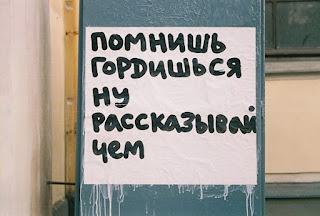
Around 3 years ago, people strolling along St-Petersburg streets could see these strange paper posters attached to walls. Each of them contained some short but intriguing and mystifying phrase. Startled people started to take photos of these papers and to post them on Internet, while asking each other: "Do you know what all that means?".
Here are these strange posters. Imagine you walking on the street and seeing these things:

"Better than nothing" is worse than "just cool". 

Tourists are freaking performance

The winter's come, the winter's gone, but summer is the summer. 

You remember, you are proud, then tell us what you're proud of

(It refers to the famous slogan of the social advertising campaign launched before the anniversary of the 1945 victory of Russia over the Nazi Germany: "I remember, I'm proud". It was the real epidemic campaign -  so-called "Georgian ribbons" (orange and black striped ribbons of color of the highest military Russian award, St. George's order) were spread among all people, distributed in schools, workplaces, just on the streets. People attached them on their cars, bags, clothes, to show that they remember veterans, but due to this immense popularity it soon became a vice: teenagers decorated themselves by these ribbons, but they didn't know anything about the Great Patriotic War). 

I'll buy, I'll sell, I'll get profit


However, the secret was quickly disclosed, because the author hadn't even thought of remaining anonymous.
Agon_noga is the street art activist from St-Petersburg. His works created in the conceptual style, aren't aimed for high artistic value. Their purpose is the close interaction with viewers. So, the artist fully achieved this goal.

Friday, September 7, 2012

Street art

Sometimes we've encountered with strange slogans written or printed on walls. Some of them can look like a complete nonsense, some of them are remembered by us and make us laugh. Some of them look strange, some are surprisingly accurate in describing of the current situation. It's the anonymous voice of the city - people who write it are unknown. It's like walls are speaking with passer-bys. I have several examples, made on Russian, but of course, there are a lot of them on English, German or Dutch, since the street art is well-developed in Europe...
Here they are:
The city has become absolutely ugly... Nothing like in the USSR.

This comment written on the dull grey concrete wall is very ironic and may be it reflects feelings of citizens. 

The wife who is an artist is the trouble of family.

I think, it's true to some extent...) Judge by myself (though I'm not an artist in the proper sense).

There wasn't any spleen - but then we downloaded "Hachiko".

The name of this sentimental movie during watching of which no one can avoid tears has become the synonym of all sentimental and tear-squezzing art. 

I'd been standing here for some time, and then I left...

The very good way to mark someone's previous presence in the certain place, so popular among teenagers and youngsters crowding in the public spaces. Better than banal "Vasya has been here"

"We are to grow spiritually. Or it'll be collapse".

The last warning, I guess...

Putin is an illusion.

The name of the current Russian president has also become the part of popular mythology. The man who's concealed his past and his personal life, but has become the symbol of relative wealth and stability cherished by ones and hated by others is the centre of attention. Myths circulate about him. And here we see the picture of the duck who's opened its beak just to say what many people think of Putin - that he's an illusion.